“The death last week of Thomas Clayton Wolfe shocked critics with the realization that, of all American novelists of his generation, he was the one from whom most had been expected.” Time Magazine

Thomas Clayton Wolfe was the youngest of eight children of Julia Elizabeth (Westall) and William Oliver Wolfe of Asheville, North Carolina. His father was a stone carver and had a gravestone business. He had an angel in his store window which is the angel described in Look Homeward Angel. The angel is now located in Oakdale Cemetery in Hendersonville, North Carolina. His mother bought and sold a series of boarding houses and was a successful real estate speculator. She temporarily moved the family to St. Louis in 1904 where she ran a boarding house during the World’s Fair taking place in the city.
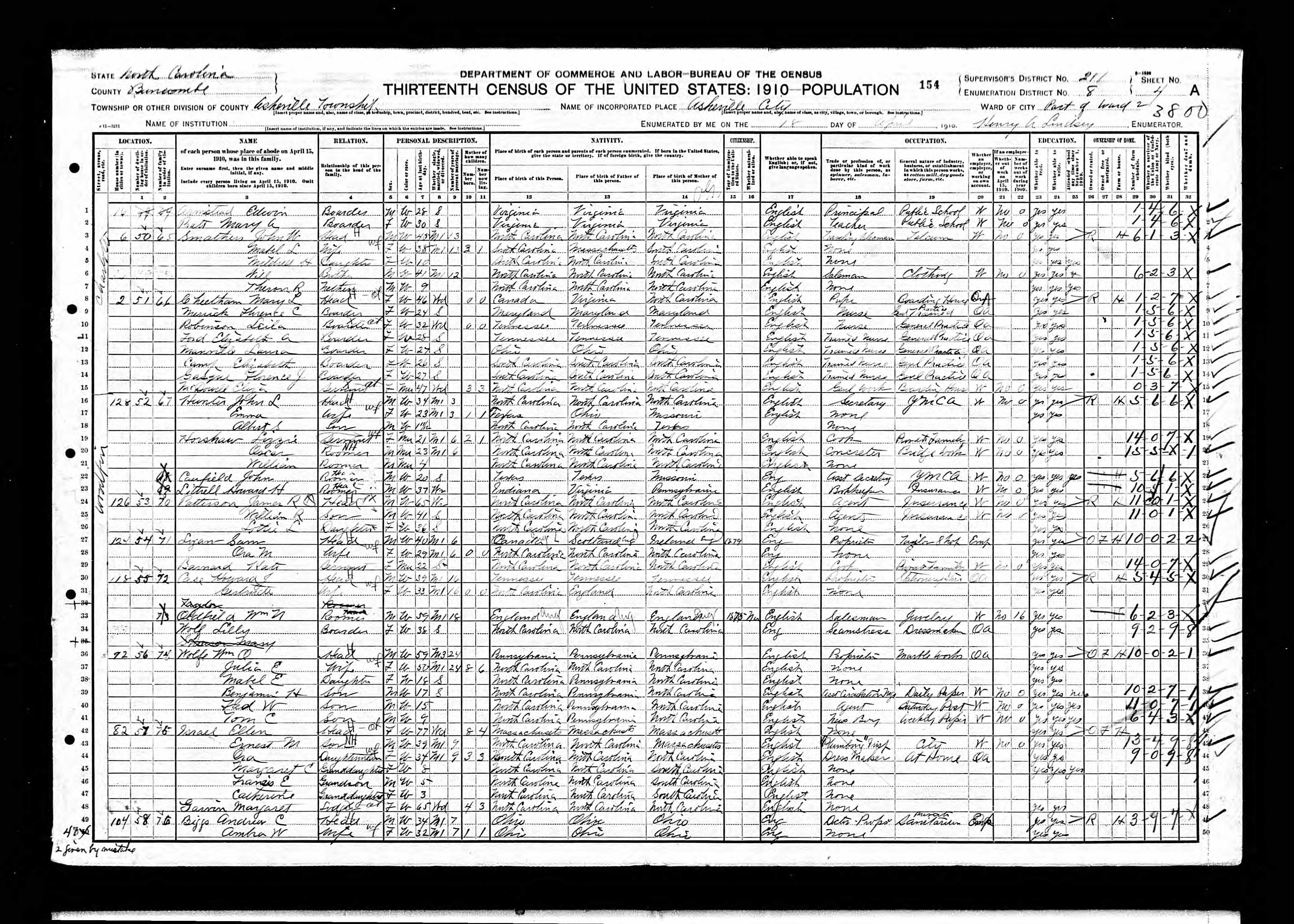
According to the 1910 Asheville census, 9-year-old Tom Wolfe lived with his parents, sister, and two brothers at 92 Woodfin Street. His father was running the marble works while older brother Benjamín delivered a daily paper, brother Fred delivered The Saturday Post, and Tom delivered a weekly paper. It appears they had come together for the purposes of the census because his mother Julia had purchased a boarding house called Old Kentucky Home. She lived there with Tom. This was his home until he was 16, and is now The Thomas Wolfe Memorial.
This census sheet shows 15 lodgers out of 49 entries. Six nurses are living in one boarding house, There is a school principal and a teacher and assorted occupations such as two insurance agents, a cook, a plumber, a traveling salesman, and a doctor at a sanatorium. There are two Canadian immigrants and one from England.
Later life
Wolf graduated from the University of North Carolina, earned a master’s degree from Harvard and began teaching at New York University. He was a playwright during this period, but while some of his plays were performed at colleges, his plays were generally too long to be sold commercially. He went to Europe in 1924 to work on writing fiction and returned in 1926.
He began work on an autobiographical novel titled O Lost which became Look Homeward Angel. The 1100 pages of the book were edited by prominent editor Maxwell Perkins who cut the length and changed the focus to the character of Eugene Gant. The setting was Asheville, the characters were Wolfe, his family, and real citizens of the city. All characters were renamed – Wolfe became Eugene Gant – and the city name was changed to Altamont. When the book was published it caused a sensation in Asheville. Many characters were easily identified as their real-life inspirations. Wolfe stayed away from Asheville for eight years. The book was an international bestseller.
His next novel was a multi-volume epic called The October Fair. Perkins cut it down to one volume called Of Time and the River which sold better than Look Homeward Angel and once again upset the citizens of Asheville because this time they were not mentioned.
Wolfe spent a lot of time in Germany, had many friends, and was very comfortable there. In 1936, the political climate of the country and Wolfe’s observations of the treatment of the Jews there caused him to return to the United States. He published I Have a Thing to Tell You, a story about his time in Germany. The German government banned his books and prohibited him from returning to the country.
In 1938, while in Seattle, Wolfe was diagnosed with pneumonia and then with miliary tuberculosis. After being sent to Johns Hopkins Hospital and undergoing an operation that revealed the disease had taken over the right side of his brain, he died without regaining consciousness.
He left two complete unpublished novels in the hands of his publishing company. The Web and the Rock, and You Can’t Go Home Again were both published posthumously. In 2000 F. Scott Fitzgerald scholar Matthew Bruccoli reconstructed an “author’s cut” of O Lost which he states “marks nothing less than the restoration of a masterpiece to the literary canon”.
For full information on Thomas Wolfe see his Wikipedia entry.
Other happenings on October 3, 1900:
- Apolinario Mabini, who had been the first Prime Minister of the First Philippine Republic during its temporary independence from Spain, was briefly released from prison by American authorities despite his refusal to take an oath of allegiance to the United States. After continuing his criticism of the American territorial administration and of Filipino collaborators, Mabini would be re-arrested, and deported to Guam.
- The Dream of Gerontius, written by Edward Elgar, was first performed in Birmingham, England. With less than two weeks of rehearsal, the debut under the direction of Hans Richter was a disaster. One observer noted that the concert “seemed to continue for an eternity … it was evident that the chorus did not know the parts they were trying to sing … The whole thing was a nightmare.”
- The Wright brothers began their first manned glider experimental flights at Kitty Hawk, North Carolina, three years before their powered flight.
Tomorrow – A vampire writer
Please subscribe to our newsletter to receive each day’s entry in your email box.
Sources
- Wikipedia.org
- Ancestry.com
- Onthisday.com
- Picryl.com
- Youtube.com
 Famous People and Their First Census